



Roller Shelf Solution: Keep Your Retail Display Facing Forward
08 January 2026



Commercial refrigerator wire shelves must do more than provide storage space. For refrigeration equipment manufacturers, beverage cooler brands, supermarket display cabinet suppliers, and commercial refrigeration distributors, the right shelf configuration needs to fit the cabinet, support the intended load, withstand the operating environment, and remain consistent throughout mass production.
Custom refrigerator wire shelves allow OEM buyers to specify dimensions, wire structure, mounting features, surface finish, and other requirements according to their equipment designs. Rather than selecting a shelf based on size alone, buyers should evaluate the complete specification before approving a sample or placing a production order.
In this guide, ORIO explains the key factors to consider when sourcing custom wire shelves for commercial refrigerators and freezers, from material selection and dimensional requirements to manufacturing quality and OEM/ODM cooperation.
Custom refrigerator wire shelves are metal shelving components manufactured to meet the dimensional, structural, and functional requirements of a specific refrigeration unit or display application.
Unlike standard replacement shelves, custom designs can be developed around the cabinet's internal dimensions, mounting system, intended products, and operating conditions.
Common applications include:
Commercial upright refrigerators and freezers
Glass-door beverage coolers
Supermarket refrigerated display cabinets
Convenience store refrigeration equipment
Commercial kitchen refrigeration units
Bakery display and refrigerated storage equipment
Depending on the application, a wire shelf may feature a flat grid structure, reinforced perimeter frame, specialized mounting points, or a customized shape to accommodate the cabinet layout.
For OEM projects, the objective is to achieve a suitable balance between structural stability, installation compatibility, cleaning requirements, and manufacturing cost.
A successful custom refrigerator wire shelf project starts with a clear technical specification. The following parameters should be confirmed before requesting a quotation.
Shelf dimensions determine whether the finished product fits the refrigeration cabinet and can be installed correctly.
Key dimensions include:
Overall width and depth
Front and rear frame dimensions
Mounting bracket or support-point locations
Wire spacing and grid configuration
Required clearances around cabinet components
Dimensional tolerances for critical interfaces
Nominal width and depth alone may not be sufficient. Two shelves with identical external dimensions can have different mounting structures and may not be interchangeable.
For replacement projects, buyers should provide the existing shelf, a technical drawing, or clear photographs with measurements. For new equipment development, the cabinet interface drawing is generally the most useful starting point.
OEM recommendation: Confirm critical dimensions and mounting details before tooling or sample production. This helps reduce the risk of installation problems during final assembly.
The wire diameter and structural arrangement affect shelf rigidity, load distribution, and overall product weight.
Important design factors include:
Main frame wire diameter
Cross-wire diameter and spacing
Number and position of reinforcement wires
Perimeter frame geometry
Welding locations and joint consistency
Shelf span and support configuration
A larger wire diameter does not automatically guarantee better performance. The complete structure, material properties, weld quality, shelf dimensions, and support locations must be considered together.
For example, a shelf intended to hold packaged beverages may require a different reinforcement arrangement from one designed for lightweight packaged food.
The appropriate configuration should be selected according to the expected load and how products will be distributed across the shelf.
Load capacity is an important consideration when selecting commercial refrigerator wire shelves, especially for beverage coolers and other applications that store relatively heavy products.
Before specifying a load rating, buyers should clarify:
The total expected weight on each shelf
Whether the load is evenly distributed or concentrated in specific areas
The distance between shelf supports
The expected frequency of loading and unloading
Any additional requirements for deformation or long-term stability
A shelf that performs adequately under evenly distributed loading may behave differently when heavy products are concentrated near the center or front edge.
For this reason, load capacity should be associated with a defined shelf configuration and test condition rather than treated as a universal value.
ORIO's refrigerator shelf product range includes configurations with a stated load range of approximately 50–80 kg per shelf, depending on the specific design. This is a product-family reference, not a guaranteed rating for every custom shelf. Buyers should confirm the applicable capacity and validation conditions for their selected configuration.
The material and coating system influence corrosion resistance, surface durability, cleaning requirements, appearance, and suitability for the intended environment.
ORIO offers refrigerator shelf configurations made from steel wire with PE dip coating. Other material or finish requirements should be discussed and confirmed for the specific project.
Common considerations include:
PE-coated steel wire
PE-coated steel wire combines a steel structural core with a polymer surface layer. It can provide a smooth finish and protection against moisture and surface damage when the coating system is properly selected and applied.
It is worth considering for commercial refrigeration applications where the shelf requires a coated surface and regular cleaning.
Chrome-plated steel wire
Chrome-plated wire may be suitable for applications where a metallic appearance and specific surface characteristics are required. Its performance depends on the plating system, base material, environmental exposure, and maintenance conditions.
Stainless steel wire
Stainless steel may be appropriate for applications with more demanding corrosion-resistance or hygiene requirements. The suitable grade should be selected according to the operating environment and project specifications.
These options are not interchangeable in every application. Before choosing a finish, buyers should evaluate operating temperature, condensation, cleaning chemicals, expected service conditions, and budget.
For any food-contact application, confirm that the actual material and coating are suitable for the intended use and that the required compliance documentation is available. Do not assume that every coating is food-contact compliant simply because it is used on a refrigerator shelf.
Shelf color can influence the appearance of the cabinet interior and the visibility of displayed products.
Depending on the product configuration and manufacturing process, buyers may specify a preferred color or finish to match the equipment design.
White-coated shelves are commonly used in refrigeration interiors, while other finishes may be considered for particular commercial applications.
Color requirements should be confirmed during the quotation and sample approval stages, including any applicable color tolerance and appearance criteria.
Different refrigeration applications have different structural and operational requirements. A suitable shelf design should reflect how the equipment will be used.
Application | Key Considerations |
Beverage coolers | Bottle and can stability, shelf loading, mounting compatibility, and product visibility |
Supermarket display refrigerators | Product arrangement, shelf spacing, cleaning access, and compatibility with the display cabinet |
Commercial freezers | Operating temperature, coating suitability, moisture exposure, and structural performance |
Commercial kitchen refrigerators | Cleaning conditions, hygiene requirements, durability, and ease of removal |
Bakery refrigeration equipment | Product dimensions, shelf layout, surface finish, and cleaning requirements |
Open-wire construction can provide more open area than a solid shelf, which may help accommodate airflow within a refrigeration cabinet. However, actual cooling performance depends on the entire refrigeration system, including the evaporator, fan arrangement, air-return path, shelf geometry, and product loading.
Shelf design should therefore be evaluated as part of the equipment rather than selected on the assumption that one grid structure will suit every cabinet.
For refrigeration equipment manufacturers and brands, customization can help ensure that wire shelves match the intended cabinet design and production requirements.
Depending on the project, customization may include the following.
Shelf width, depth, grid arrangement, frame geometry, and mounting features can be specified according to the customer's drawings or product requirements.
For new equipment projects, the design should be reviewed against the cabinet structure before the sample is approved.
Wire diameter, spacing, reinforcement arrangement, and overall construction can be evaluated according to the intended loading conditions.
The final configuration should be agreed upon using the required performance criteria and applicable validation results.
The coating or finish should be selected according to the required appearance, environmental conditions, cleaning practices, and compliance requirements.
Material and finish availability should be confirmed during the technical review.
For OEM programs, customers can provide technical drawings, reference samples, or detailed specifications for evaluation.
The manufacturing team can then review feasibility, confirm critical dimensions, and establish the requirements for sampling and production.
For ODM projects that require design development, the initial discussion should cover the intended application, cabinet interface, performance expectations, and any special structural requirements.
Manufacturing consistency is important because dimensional or coating variations can affect installation, appearance, and product performance.
Depending on the selected design, the manufacturing process may include the following stages.
Step 1: Material preparation
Steel wire is selected and prepared according to the approved product specification.
Step 2: Wire cutting and forming
The wire is cut, bent, and formed into the required frame and grid components.
Step 3: Welding and structural assembly
The formed components are joined according to the approved design. Weld locations and consistency should be checked to support structural stability.
Step 4: Surface treatment
The shelf receives the specified surface finish, such as PE dip coating, where applicable. The coating process should provide appropriate coverage and adhesion for the intended application.
Step 5: Dimensional and visual inspection
Finished shelves are checked against the relevant drawings and acceptance criteria. Depending on the project, inspection may include overall dimensions, mounting interfaces, weld condition, coating appearance, and other specified requirements.
Step 6: Packaging and shipment
Approved products are packaged according to the agreed requirements to help prevent damage during handling and transportation.
For OEM production, the approved drawing, sample, material specification, and inspection criteria should remain aligned throughout the production process.
A professional supplier should be able to discuss how product quality is evaluated and which inspection records are available for the selected shelf.
Before mass production, buyers should consider confirming the following:
Dimensional accuracy: Critical dimensions and mounting points match the approved drawing.
Structural integrity: Welding and reinforcement meet the agreed requirements.
Load performance: The shelf meets the specified load criteria under defined test conditions.
Coating quality: Surface coverage, adhesion, and appearance meet the agreed acceptance criteria.
Environmental suitability: The material and finish are appropriate for the intended temperature, moisture, and cleaning conditions.
Production consistency: The manufacturing process maintains the approved specifications across production batches.
Packaging protection: Packaging is suitable for the product structure and shipping conditions.
Testing should be based on the requirements of the actual project. If a customer needs a particular corrosion test, coating test, or compliance document, the method, acceptance criteria, and documentation scope should be agreed upon before production.
Providing complete project information helps manufacturers evaluate feasibility and prepare a more accurate quotation.
When contacting a refrigerator wire shelf manufacturer, prepare as much of the following information as possible:
Information | Details to Provide |
Application | Refrigerator, freezer, beverage cooler, or display cabinet |
Dimensions | Required shelf width, depth, and critical tolerances |
Mounting structure | Support locations, bracket design, or cabinet interface drawing |
Material | Preferred base material, if specified |
Surface finish | PE coating or another requested finish |
Load requirement | Expected weight per shelf and loading pattern |
Operating environment | Temperature, condensation, and cleaning conditions |
Order quantity | Initial quantity and estimated recurring demand |
Customization | Special shapes, reinforcement, colors, or other requirements |
Quality documentation | Required inspection reports and compliance documents |
Packaging | Individual protection, bulk packaging, or export packaging requirements |
If the design is not finalized, buyers can start with the cabinet dimensions, intended application, target load, and reference photographs. The supplier can then review which additional details are required.
ORIO specializes in OEM and ODM manufacturing for commercial refrigeration and retail display applications, including refrigerator shelves, freezer racks, gravity roller shelves, and related display accessories.
Our manufacturing operation includes a 48,000 m² facility, more than 600 employees, and over 300 pieces of manufacturing equipment. Our capabilities cover product development, wire processing, welding, surface treatment, assembly, and quality inspection across our product portfolio.
For custom refrigerator wire shelf projects, ORIO can discuss requirements relating to dimensions, shelf structure, mounting compatibility, surface finish, and intended application.
Our goal is to help customers establish a practical specification before sampling and production, reducing avoidable fit issues and supporting consistent manufacturing.
Whether you are developing a new commercial refrigerator, sourcing replacement shelves, or evaluating a customized component for an existing product line, the first step is to define the cabinet interface and performance requirements.
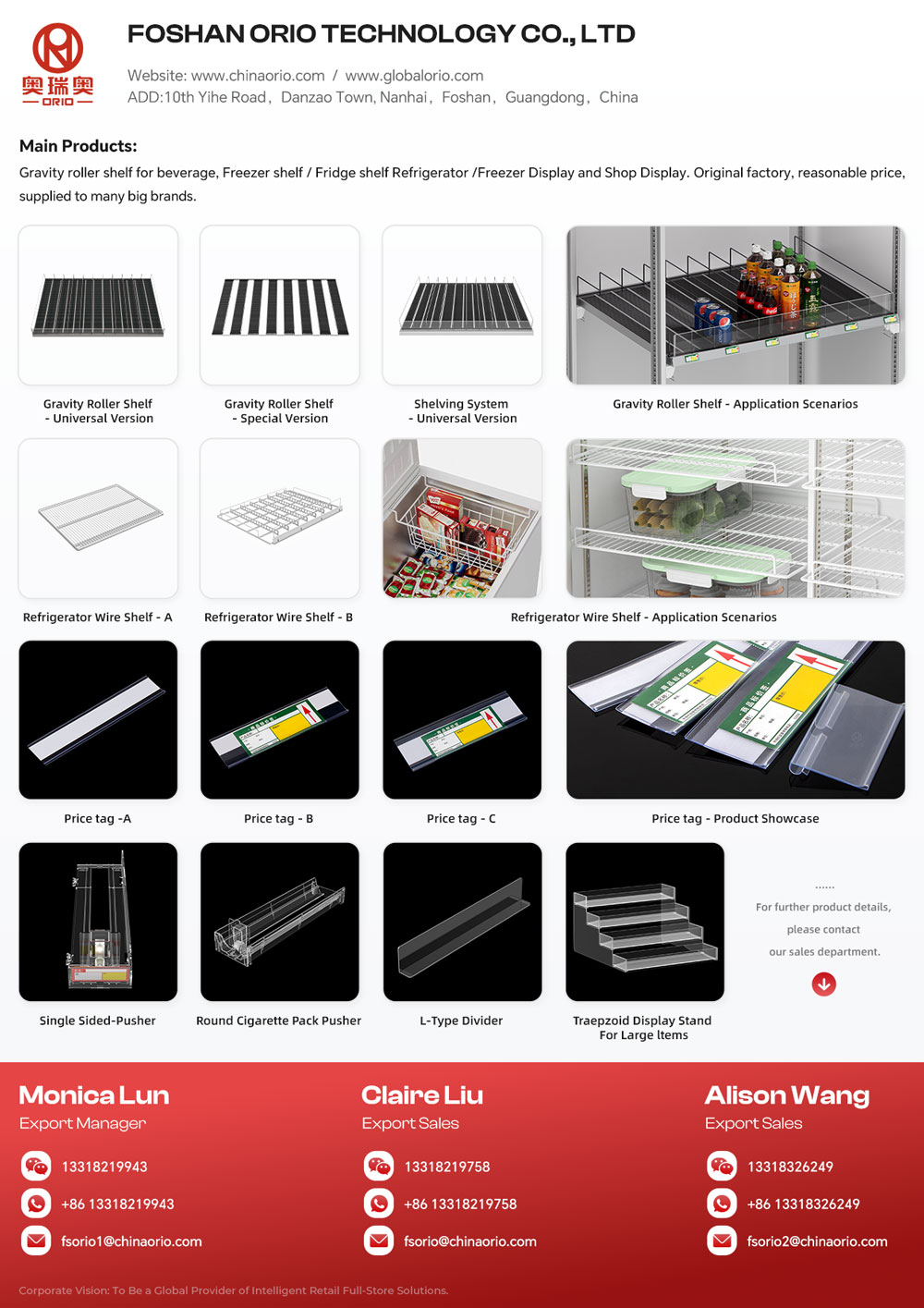
Looking for a reliable OEM/ODM partner for commercial refrigerator wire shelves?
Contact ORIO with your drawings, dimensions, application requirements, or reference samples. Our team can review your project requirements and discuss a suitable manufacturing solution for your commercial refrigeration equipment.
Request a Quote to discuss your custom refrigerator wire shelf project with ORIO.
Yes. Customization can be evaluated according to cabinet dimensions, mounting structure, required load, and other project specifications. Providing a drawing or reference sample helps clarify the design requirements.
The most useful information includes shelf dimensions, mounting details, expected load, material and surface finish preferences, operating conditions, and order quantity. A technical drawing is helpful when available.
Start with the total expected product weight and its distribution across the shelf. The final rating should be confirmed for the selected geometry, material, support arrangement, and defined test conditions.
The appropriate finish depends on the operating environment, corrosion exposure, cleaning requirements, appearance, and applicable compliance requirements. PE-coated steel wire is one option offered within ORIO's refrigerator shelf range. Other options should be confirmed for the specific project.
Sample arrangements can be discussed during project evaluation. Buyers should confirm the sample configuration, cost, lead time, and required fit or performance checks with the ORIO team before proceeding.
Send your application details, dimensions or drawings, expected load, surface finish requirements, and estimated quantity. If some specifications are not yet available, explain the intended use so the requirements can be reviewed before quotation.


