



Roller Shelf Solution: Keep Your Retail Display Facing Forward
08 January 2026



When planning a cigarette display cabinet, buyers often focus on product features, pricing, and supplier selection. However, size compatibility between the cabinet, cigarette packs, and pusher system is equally important.
An incorrectly sized Cigarette Pusher can reduce usable shelf space, cause products to lean or jam, and make replenishment more difficult. Whether you choose a Standard Cigarette Pusher, Adjustable Cigarette Pusher, Counting Cigarette Pusher, or Split Pusher, the system should be selected according to the cabinet's usable dimensions and the products being displayed.
For this reason, understanding common Cigarette Pusher dimensions and shelf planning principles is essential before installing any retail display system.
Cigarette pusher size is mainly determined by track length, channel width, product dimensions, and available shelf depth. Common track length configurations may include 285 mm, 385 mm, 485 mm, and 585 mm or longer, depending on the pusher design and cabinet configuration. Channel width should be selected according to the actual width of the cigarette pack and the clearance required for smooth product movement.
The correct size should not be selected from track length alone. Before ordering, measure the cabinet's usable shelf depth, available shelf width, cigarette pack dimensions, required number of lanes, and mounting space.
Dimension | What It Determines | Typical Consideration |
Track length | Number of packs per lane | Match cabinet depth |
Channel width | Product fit and stability | Match pack width |
Pusher height | Product support | Match pack height |
Lane quantity | Number of SKUs | Match assortment |
Clearance | Smooth product movement | Avoid excessive friction |
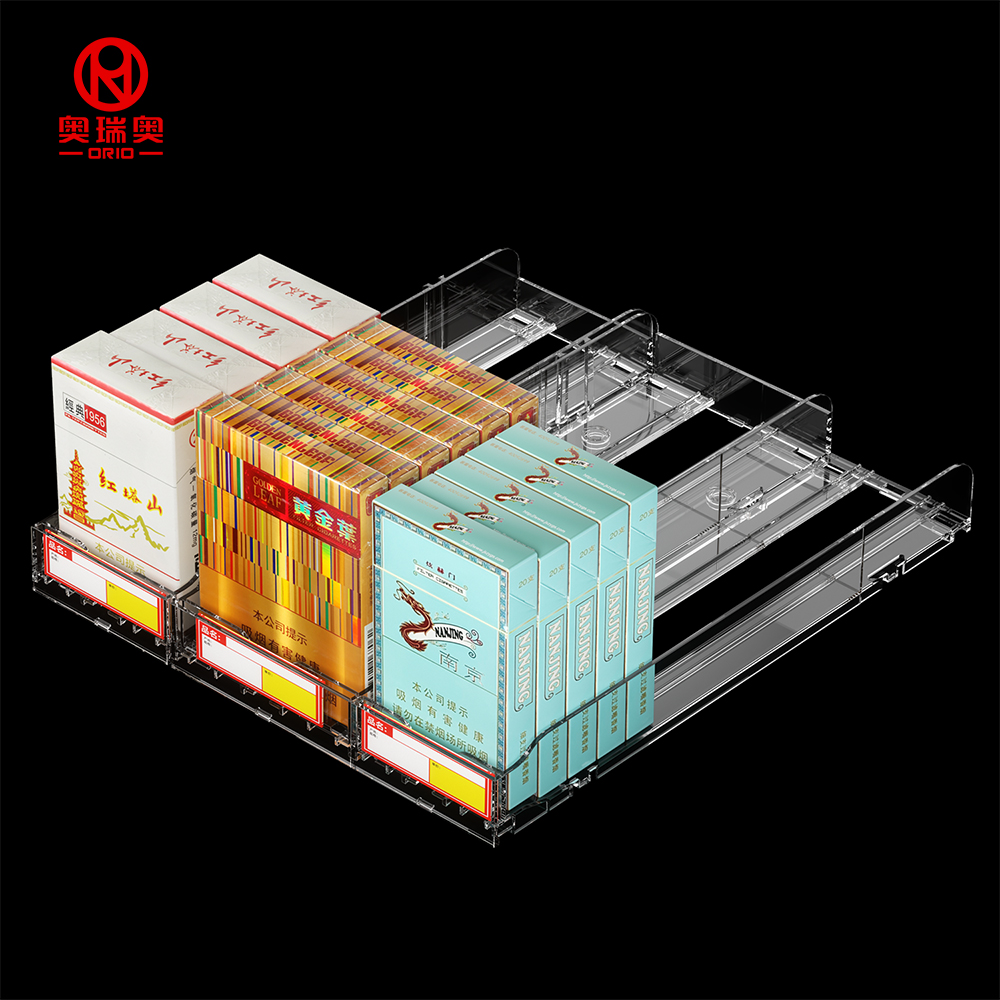
Many retailers assume that as long as a pusher fits inside a display cabinet, it will work properly. In practice, the pusher, shelf, cabinet, and cigarette pack should be treated as one integrated merchandising system.
If the track is too long for the available shelf depth, installation and replenishment can become difficult. If the channel is too wide, products may move sideways or appear poorly aligned. If the channel is too narrow, friction can prevent packs from moving smoothly.
Correct sizing therefore affects more than installation. It can influence product stability, front-facing presentation, shelf capacity, replenishment efficiency, and long-term flexibility.
For custom display projects, cabinet dimensions should be confirmed before finalizing the pusher configuration.
Cigarette pushers are available in different configurations depending on the manufacturer, product format, and display cabinet design. There is no single universal cigarette pusher size that fits every retail cabinet.
The most important dimensions to consider are track length, channel width, pusher height, and available mounting space.
Track length determines how many cigarette packs can be stored within a single lane.
Common sizes include:
Track Length | Typical Use |
285 mm | Shorter or shallow shelf configurations |
385 mm | Common medium-depth shelf configurations |
485 mm | Deeper shelf configurations |
585 mm+ | Extended or high-capacity configurations |
These dimensions are common reference configurations rather than universal industry standards. Actual available sizes depend on the pusher model and manufacturer.
When selecting track length, measure the usable shelf depth available for the pusher, rather than using the overall cabinet depth. The pusher should normally leave sufficient space for installation, product loading, and replenishment.
Channel width determines how securely cigarette packs are positioned and how smoothly they move along the track.
The correct channel width should be selected according to the actual product width, rather than assuming that all cigarette packs have identical dimensions. The channel should provide enough clearance for the pack to move forward without excessive side-to-side movement.
For fixed product assortments, a fixed-width pusher can provide a simple and economical solution. When a cabinet needs to accommodate different pack widths or frequently changing SKUs, an adjustable pusher can provide greater flexibility.
Before selecting a channel width, measure the actual cigarette pack and confirm the required clearance with the pusher manufacturer.
Before ordering cigarette pushers, collect the following measurements:
1. Usable shelf depth
Measure the actual depth available for the pusher after accounting for the cabinet structure and mounting components.
2. Available shelf width
Determine the total width available for the pusher lanes.
3. Cigarette pack dimensions
Measure the actual width, depth, and height of the products to be displayed.
4. Required number of lanes
Determine how many SKUs or product rows need to be displayed on each shelf.
5. Mounting space
Check whether the pusher requires clips, rails, dividers, or other mounting components.
6. Future SKU changes
If product sizes or SKU assortments may change, consider an adjustable or modular configuration.
For custom projects, providing these measurements to the manufacturer can help reduce installation problems and avoid unnecessary modifications after production.
While Cigarette Pushers share the same basic function, different product types offer different sizing options and installation flexibility.
Standard pushers typically feature a fixed channel width and a simple structure.
They are designed for projects where product sizes remain consistent over time.
Common applications include:
Tobacco shops
Small convenience stores
Fixed-SKU display cabinets
Advantages include lower cost, easy installation, and straightforward maintenance.
Adjustable systems allow retailers to modify channel widths according to product dimensions.
This makes them particularly useful for stores displaying both standard cigarette packs and slim-pack products.
The ability to adjust channel sizes helps maximize shelf utilization and reduces the need for future modifications.
Counting Cigarette Pushers combine product front-facing with inventory monitoring functionality.
While their basic dimensions are similar to standard systems, additional space may be required for counting components and installation accessories.
These systems are often used in:
Convenience store chains
Large retail projects
High-SKU tobacco displays
Their primary advantage is improved inventory visibility and replenishment efficiency.
When selecting a counting pusher, buyers should also confirm the space required for the counting mechanism, sensors, wiring, or other integrated components, depending on the product design.
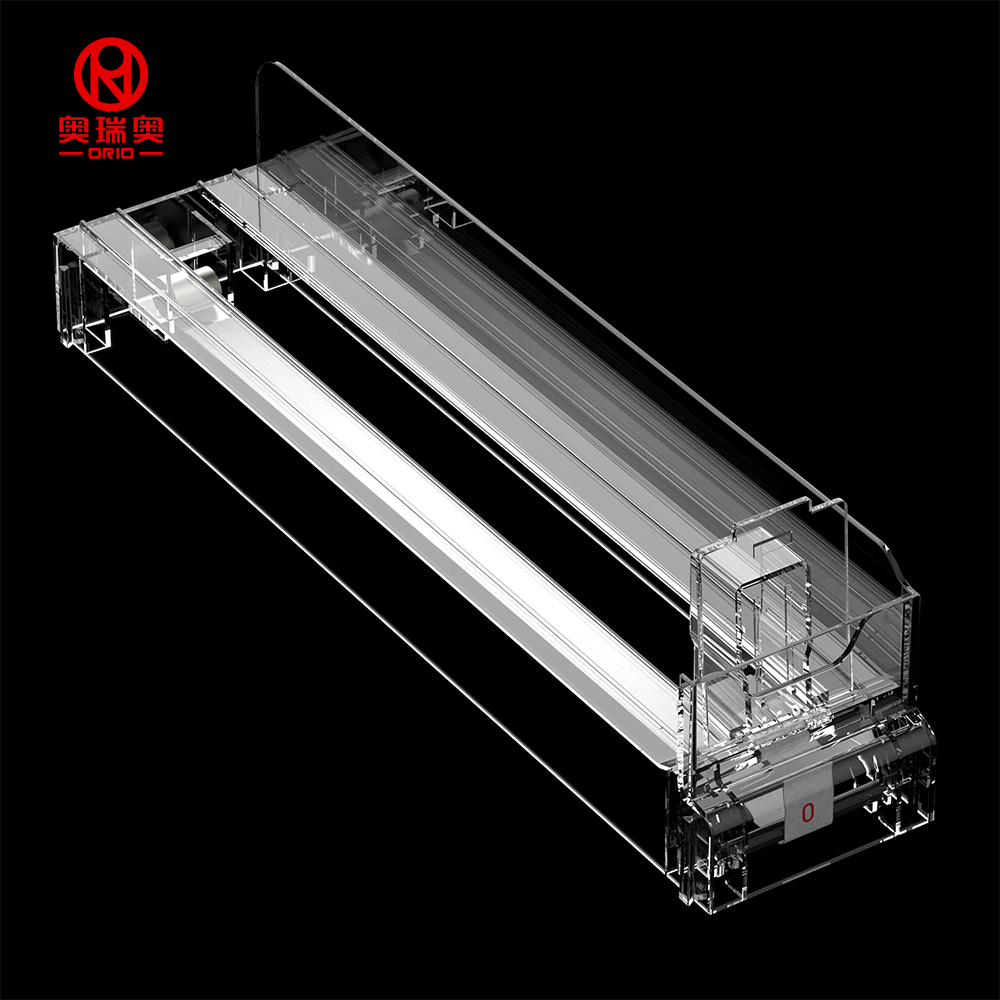
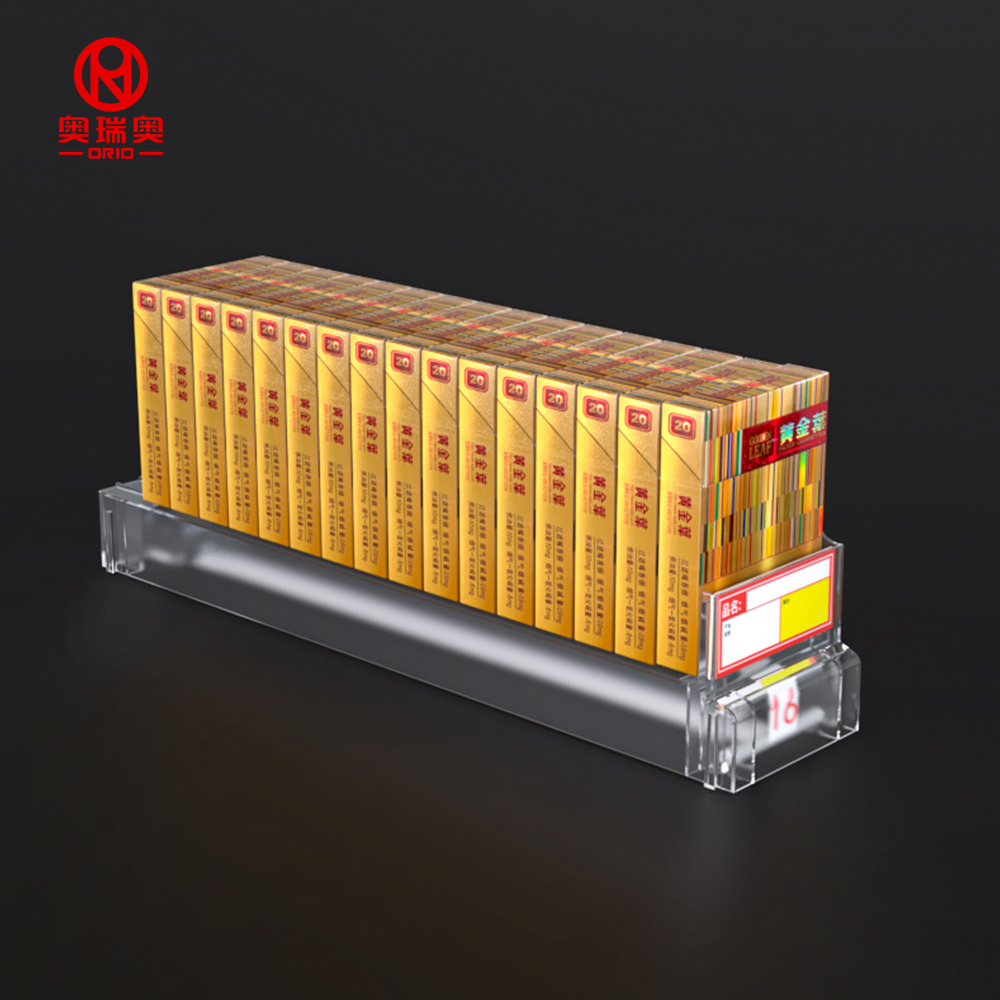
ORIO Counting Cigarette Pusher
Product Name | Item | Content |
Counting Cigarette Pusher | Material | PS + 201 Stainless Steel |
Specifications | Standard Version / Soft Pack Version / Medium Cigarette Version / Slim Cigarette Version | |
Application Scenarios | Placed in cigarette cabinets or shelves to display boxed products such as cigarettes and medicines |
1. Physically counts the number of placed cigarettes for easy statistics.
2. Can display 4 types of cigarettes.
3. Same-spec pushers can be freely spliced (stable and reliable); splicing width = 60.5mm*N + 4mm
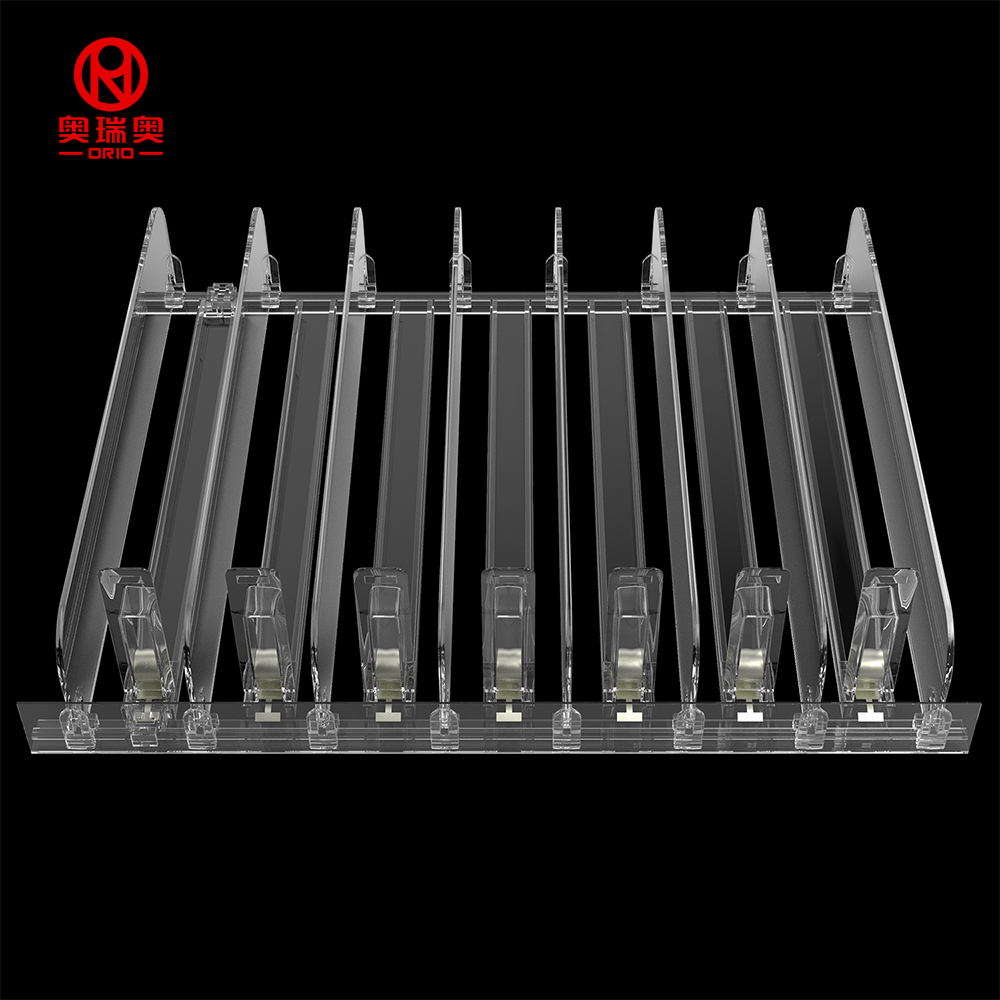
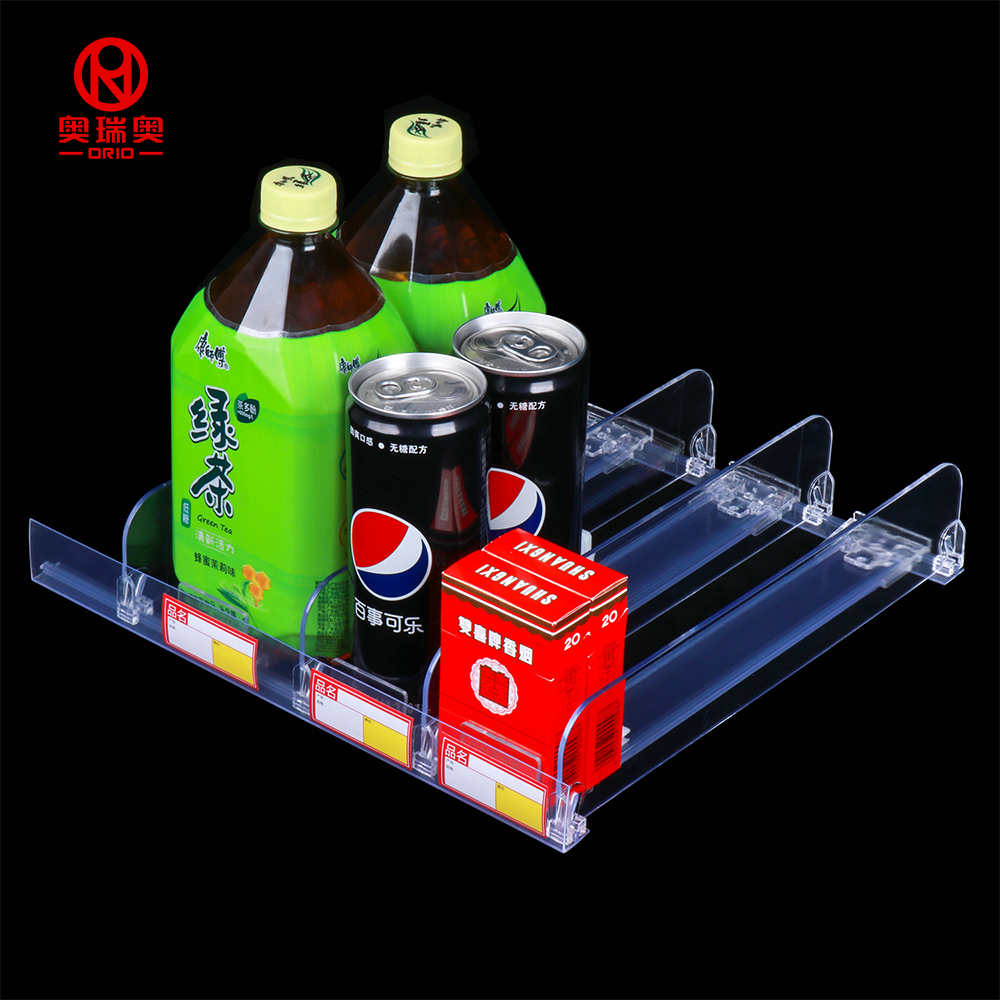
Split Pusher systems use modular components that can be configured according to the available shelf dimensions. They can be useful for custom cabinets, segmented shelves, or projects where a single continuous track is not suitable.
When selecting a split system, confirm the total assembled length, individual module dimensions, connection points, and available mounting space.
Advantages include:
Flexible installation
Easy customization
Improved compatibility with special cabinet designs
Product Name | Item | Details | Content |
Split Pusher | Material | Guide Rail | PVC |
Pusher Head | 40-width: PS / 19-width: PS | ||
Front-Back Splicing Body | PC | ||
Spring | 201 Stainless Steel | ||
Specifications | 19-width | Depth: 24cm/30cm/35cm | |
40-width | Depth: 24cm/30cm/35cm/38cm/48cm/58cm | ||
Application Scenarios | 19-width | Suitable for displaying small products (nail polish, e-cigarettes, etc.) | |
40-width | Suitable for displaying boxed/bottled products (beverages, cigarettes, etc.) | ||
Matching Accessories | PVC Fixed Guide Strip / Injection Molded Divider | ||
1. Splicing structure with multiple sizes and adjustable width, applicable to the display of more products.
2. Front raised structure for easy product access.
Selecting the correct pusher dimensions is only one part of shelf planning. Retailers should also consider SKU quantity, product dimensions, sales volume, shelf accessibility, and future assortment changes.
When designing a cigarette display cabinet, retailers should first determine the number of SKUs they intend to display.
For example, if a shelf is designed to display 20 individual SKUs, the layout should provide enough lanes or product positions for those SKUs while maintaining sufficient space for replenishment.
Product sales volume should also be considered. Best-selling items are usually placed in the most accessible positions, while slower-moving products can be displayed in secondary areas.
Efficient shelf organization can simplify replenishment, maintain consistent product presentation, and make better use of available cabinet space.
A convenience store operator installed two cigarette display cabinets of identical dimensions.
One cabinet used fixed-width pushers, while the other used adjustable systems.
After several months of operation, the store introduced new cigarette SKUs with different package sizes. The adjustable system accommodated the changes immediately, while the fixed-width configuration required lane modifications and additional labor.
Although both cabinets shared the same physical dimensions, the more flexible shelf design resulted in lower long-term operating costs.
This example highlights why many retail chains increasingly prioritize shelf adaptability during display planning.
Item | Common Specification |
Track Length | 285 mm / 385 mm / 485 mm / 585 mm |
Channel Width | 40–80 mm |
Pusher Height | Customized according to product size |
Compatible Pack Width | 40–60 mm |
Installation Type | Integrated / Modular |
These figures are general reference configurations only. Actual dimensions vary by product model, cabinet design, and installation requirements. For a custom project, confirm the final dimensions with the manufacturer before production.
To help a manufacturer recommend the correct cigarette pusher configuration, buyers should provide:
· Cabinet or shelf usable depth
· Available shelf width
· Cigarette pack width, depth, and height
· Number of SKUs or lanes required
· Required pusher track length
· Fixed or adjustable channel preference
· Mounting method or cabinet structure
· Whether future SKU changes are expected
For custom display projects, drawings or cabinet specifications can also help the manufacturer confirm compatibility before production.
Choosing the right cigarette pusher size requires more than matching the track length to the cabinet. Buyers should consider usable shelf depth, channel width, cigarette pack dimensions, SKU quantity, mounting space, and future product changes.
Standard pushers can work well for stable product assortments, while adjustable or modular systems provide greater flexibility for changing SKU requirements. Counting systems may require additional installation space for integrated components.
Before placing an order, measure the cabinet and products carefully and confirm the final configuration with the pusher manufacturer. This helps reduce installation issues, improve shelf utilization, and ensure consistent product presentation.
Common reference configurations include 285 mm, 385 mm, 485 mm, and 585 mm or longer, depending on the manufacturer and cabinet design. There is no single universal track length for all cigarette displays.
Measure the actual width of the cigarette pack and select a channel that provides sufficient clearance for smooth movement without allowing excessive side-to-side movement. For adjustable systems, the channel can be configured according to the product dimensions.
Yes. Adjustable systems are specifically designed to support multiple product dimensions.
Not necessarily. The relevant measurement is the usable shelf depth available for the pusher. The final track length should allow sufficient space for installation, product loading, and replenishment. Confirm the required clearance with the manufacturer before ordering.
Yes. SKU quantity directly affects the number of lanes, available shelf space, and overall cabinet layout. Future SKU expansion should also be considered when planning the display.
Many chains prefer adjustable or counting pushers because they provide greater flexibility and inventory management benefits.
Provide the usable shelf depth and width, cigarette pack dimensions, required number of lanes, mounting information, and any requirements for adjustable or counting functions. For custom cabinets, drawings or product specifications can help the manufacturer confirm compatibility.
Yes. Depending on the manufacturer and pusher design, track length, channel configuration, mounting method, and other dimensions may be customized or configured to suit specific cabinet requirements.


